Perge Ancient City History: A Journey Through Time
From Bronze Age settlement to Roman metropolis to biblical landmark, discover the fascinating 4,000-year history of one of Asia Minor's greatest ancient cities.
The Early Foundations
Hellenistic Roots of Perge
According to ancient tradition, Perge was founded by Greek settlers after the fall of Troy (c. 1180 BCE). The legendary seers Mopsus and Calchas are credited with establishing the city, giving it the ancient name "Perge" which may derive from a Hittite or Luwian word.
Archaeological evidence confirms settlement from the Bronze Age, though the city truly flourished in the Hellenistic period following Alexander the Great's campaigns (334 BCE). Under Greek influence, Perge developed its characteristic urban plan, defensive walls, and became a center of learning and commerce.
The city produced one of antiquity's greatest minds: Apollonius of Perga, whose mathematical treatises on conic sections remained definitive for nearly two millennia and influenced scientists from Kepler to Newton.
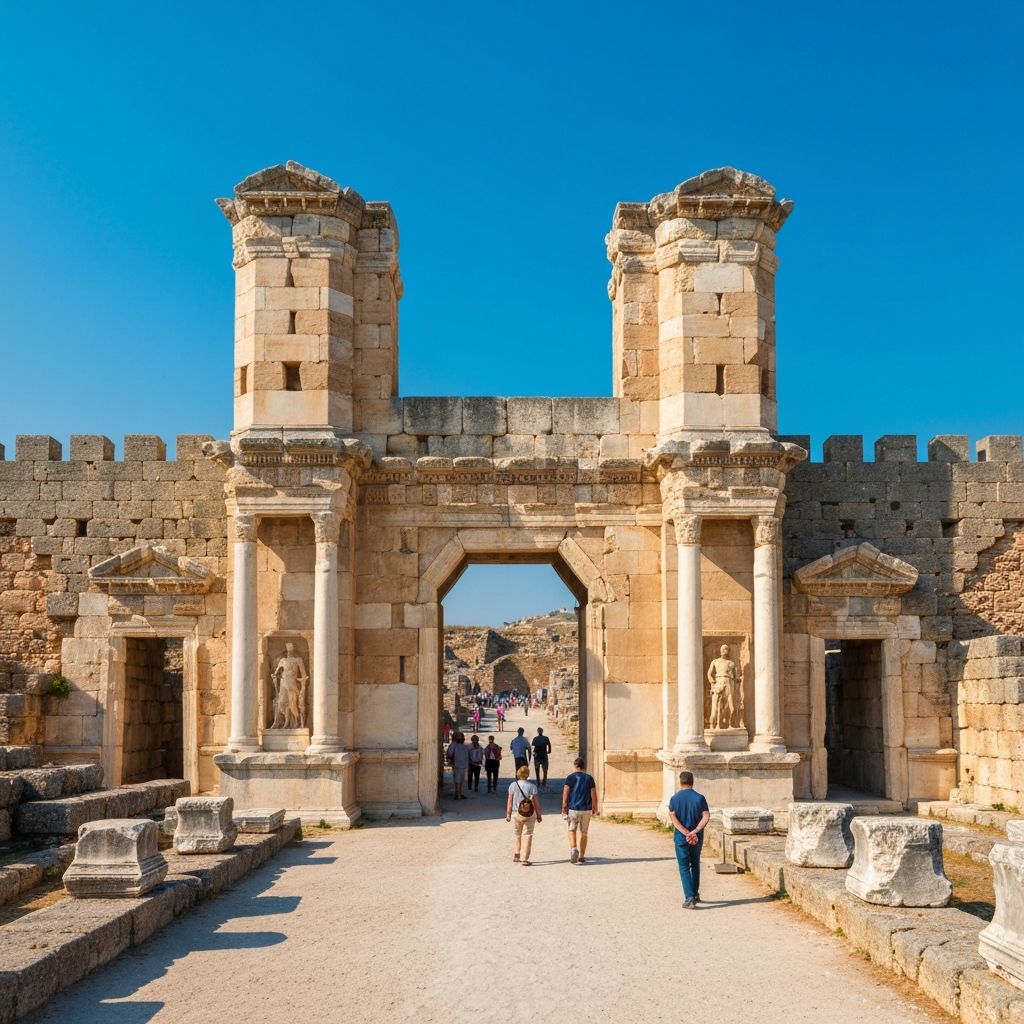
Historical Timeline
4,000 years of history from Bronze Age to modern excavations
The Roman Golden Age
When Perge became one of the greatest cities of Asia Minor

Under Roman rule (from 133 BCE), Perge experienced its greatest period of prosperity and monumental construction. The city became part of the Roman province of Pamphylia and benefited from the Pax Romana—the long period of peace that allowed commerce and culture to flourish.
During the 1st through 3rd centuries CE, Perge's wealthy citizens, particularly members of the prominent Plancii family, financed grand building projects. The massive stadium (seating 12,000), the ornate theatre (15,000 capacity), the colonnaded main street, elaborate baths, and monumental fountains all date from this era.
The city's population grew to an estimated 15,000-20,000 inhabitants, making it one of the larger urban centers in the region. Trade connections extended throughout the Mediterranean, bringing wealth and cosmopolitan culture to Perge's streets.
Explore the ArchitectureNotable Figures of Perge
The people who shaped the city's history
One of the greatest mathematicians of antiquity, Apollonius wrote the definitive work on conic sections (ellipses, parabolas, and hyperbolas). His work influenced mathematicians for over 1,800 years, including Kepler and Newton.
A wealthy Roman citizen and priestess, Plancia Magna funded major renovations to Perge's gates and public buildings. She held the rare honor of being named 'demiourgos' (chief magistrate) - one of the few women in the Roman Empire to hold such office.
The Apostle Paul visited Perga twice during his first missionary journey with Barnabas. His visits are recorded in the Book of Acts and mark an important moment in the spread of early Christianity through Asia Minor.
Perge in the Christian Era
St. Paul's Visit and the Spread of Christianity
"From Paphos, Paul and his companions sailed to Perga in Pamphylia, where John left them to return to Jerusalem."
— Acts 13:13 (NIV)
Around 46-48 CE, the Apostle Paul and Barnabas arrived at Perga during their first missionary journey, as recorded in the Book of Acts. This visit marks one of the earliest documented moments of Christianity reaching Asia Minor.
On their return journey (Acts 14:25), Paul and Barnabas preached the word in Perga before departing for Attalia (modern Antalya). While the Bible doesn't record the founding of a church in Perga, the city later became an important Christian center.
By the Byzantine era, Perge was the seat of a bishopric and home to several basilicas. Archaeological excavations have uncovered Christian inscriptions, church remains, and religious artifacts throughout the ancient city.